Tuckpointing in Springdale AR - mortar joints that keep water out of your brick
Crumbling or cracked mortar between your bricks? We find what let the water in, then rake out and refill the joints to match.
- Fully licensed and insured.
- Free in-person estimates.
- Replies within 1 business day.
Does your brick house need tuckpointing?
The short answer: Tuckpointing, which most masons also call repointing, means raking the worn mortar out of the joints between your bricks and packing in fresh mortar. For brick homes in Springdale, AR, it's one of the most effective and lasting ways to keep water out of the wall.
Most folks call us after noticing the mortar looks sandy or sunken, or after a damp spot shows up inside, and a lot of the time only one section of joints has given up. The price mostly comes down to how many joints need doing, because raking out and repacking is slow handwork. How high or hard to reach the wall is matters too, and so does whether something like a leaky gutter has to be fixed first. The schedule turns on the weather and on that same amount of wall, and if the chimney is the trouble spot, chimney repair may come into it as well. When I come out, the estimate shows you what's causing the wear, which joints need work and what it'll cost.
How can you tell if your mortar joints are wearing out?
Mortar sunk back or sandy
If the mortar sits back from the face of the brick, or rubs away like sand under your thumb, the joints have weathered down and now hold water instead of shedding it. It's rarely an emergency, but each wet winter digs them a little deeper and lets more water reach the brick behind.
Cracks along the bricks
Thin cracks in the mortar, or a gap opening between a brick and its joint, give rain a straight path into the wall. A few on an older house is normal wear, but a line of them that keeps growing is worth having me look at before the water starts working on the bricks themselves.
Stains, flaking or damp inside
White streaks on the brick, brick faces flaking off or a damp patch on an inside wall usually mean water is getting in somewhere and moving through the masonry. New mortar alone won't stop that, so the first job is finding where the water starts before it damages more brick or the wall behind it.
How we handle tuckpointing on your house
First I'll ask what you mean by tuckpointing, because some folks want worn joints renewed and some want the older decorative look, and those are different jobs. Before anyone picks up a grinder, we track down what let the water in, like an overflowing gutter, a cracked cap or a downspout dumping against the wall, so the new joints aren't fighting the same leak. Then our crew rakes the failing mortar out down to sound material and cleans out the joints. We pack in a mortar that suits the age and makeup of your wall, in layers so it sets up solid, shape the face of each joint to match the ones around it and clean the brick when we're done.
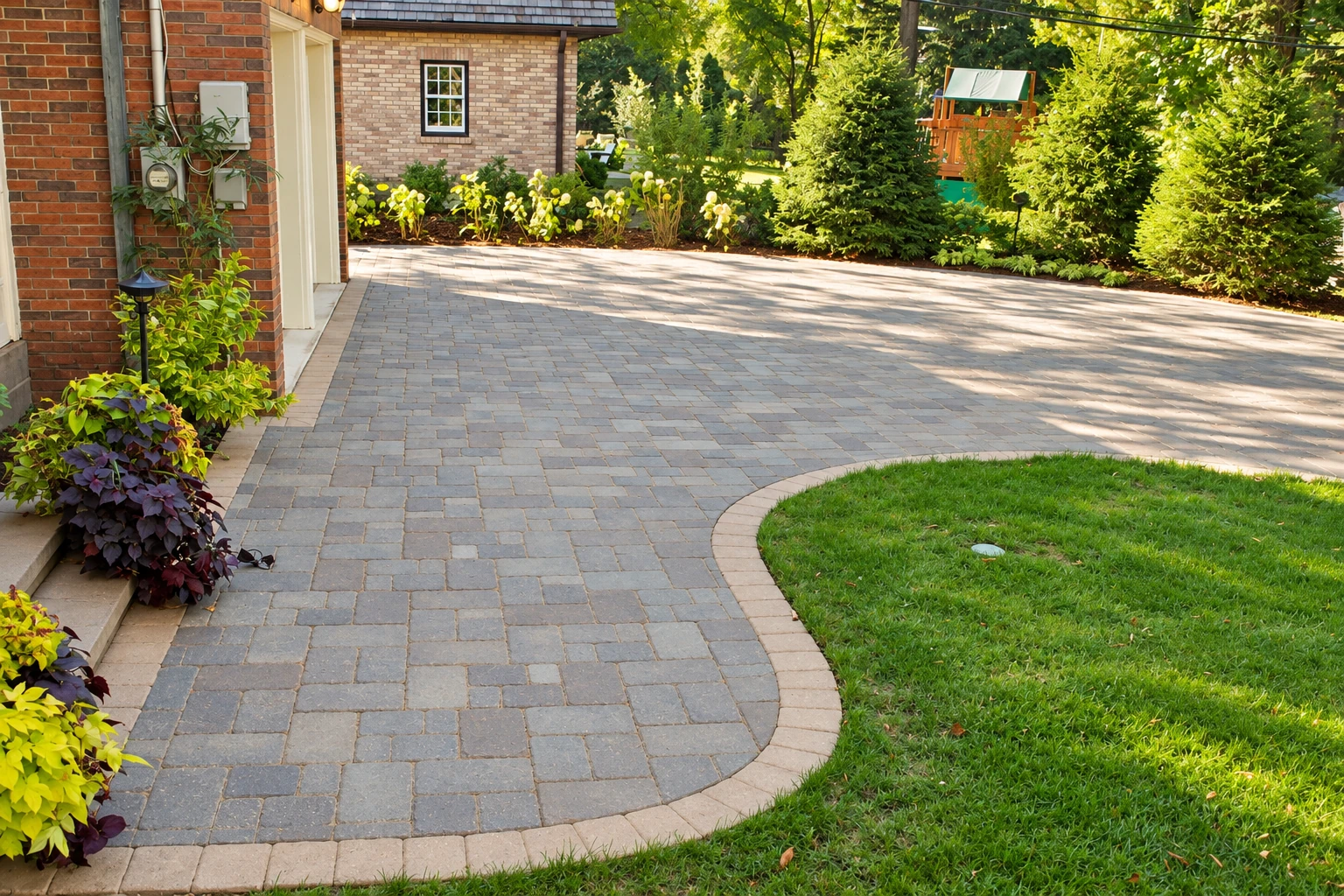
Tuckpointing often turns up a few bricks that are cracked or flaking past saving, and we handle those as brick repair while we're there so the wall comes out sound all the way through. Sometimes the water starts at the ground, from a driveway that has settled and tips runoff toward the house, and replacing it with driveway pavers laid to drain away fixes the cause along with the look.
Renewing worn joints
This is what most houses need, with the new joints matched to the shape and color of the old ones so the repair blends into the rest of the wall. It suits any brick home where the mortar has worn down but you like the look just as it is.
Traditional tuckpoint finish
The older meaning of tuckpointing is a flush joint colored like the brick, with a thin strip of contrasting mortar run along it so the brickwork looks crisp and even. It suits older homes that had it originally or owners who want that look, and it's slower, fussier work, so ask which finish any quote you get actually means.
What happens when you call us about tuckpointing in Springdale?
From the first call to the final walk-through, here's how a tuckpointing job goes with us, who you'll deal with at each step and what you'll know before you decide anything.
- Step 01
Call or send the form
Tell us what you're seeing by calling (479) 231-3391 or through the form. Photos of the worn joints and the age of your house help, since a house's age says a lot about what mortar is already in the wall.
- Step 02
I look the wall over
I come out, check the joints and the brick and work out what's behind the trouble. Then I walk you through the estimate, which covers the cause, the joints that need work, the mortar we'd use and the price.
- Step 03
We check permits and schedule
Once you're ready, we check with the city or county office for your address, and if a permit is needed we apply for it. We then set the work for a stretch without a hard freeze in the forecast.
- Step 04
We do the work together
Our crew does the raking and repointing, with me on site most of the time. When it's done, we go over the finished wall with you.
What Springdale winters do to tuckpointing
Our winters are hard on mortar because they rarely stay frozen. Long-term weather averages for Fayetteville's Drake Field show roughly 86 days a year when the air freezes overnight and thaws the next afternoon, and each of those cycles lets water in a worn joint freeze, swell and pry a little more mortar loose. That's why a joint that looked tired two years ago can be crumbling now, and why we stop the water before we repoint. We see the same wear on jobs in Fayetteville and Rogers.
In our part of the state, freezes usually show up by the last week of October and can hang on into April, sometimes into early May. Fresh mortar shouldn't freeze before it cures, so we do outside tuckpointing in the stretch between and keep a close eye on the forecast at either end.
Get a free tuckpointing estimate at your house
We'll get back to you within one business day, and there's no obligation. I'll come out, look the wall over, find what's behind the worn joints and walk you through a free estimate.
Why Springdale homeowners call Sterling Springdale Concrete and Masonry
The owner does your estimate
I'm the one who comes out to look at your wall and price the job, and I'm on site most of the time while our crew does the work. The person who figured out the problem is there while it gets fixed.
In business since 2013
I came to masonry after years working on machinery, learned the trade alongside an experienced mason and started this business in 2013. Machines taught me to find out why something broke before fixing it, and walls are no different.
Based in Springdale, working nearby
We're based in Springdale and work across the cities around it in northwest Arkansas, including the ones with pages on this site and plenty more. We live with the same freeze-and-thaw winters you do, so we plan mortar work around them.
Fully licensed and insured, every job
We're fully licensed and insured. That way you're not the one carrying the risk when a crew is on ladders and scaffolding around your house.
On a tuckpointing job, stopping the water comes before any new mortar goes in. When you're ready, send us a note about your wall and I'll come take a look.
Tuckpointing questions from Springdale homeowners
How do I know if my brick needs tuckpointing?
Your brick needs tuckpointing when the mortar has worn back more than 1/4 inch from the face, crumbles, has gaps, or shows hairline cracks or cracks between the brick and the mortar. You can check most of that from the ground with a flashlight, and those are the spots to point out to me when I come by.
How long do mortar joints last on a brick house?
Mortar joints typically last more than 25 years, while the brick itself may well go past 100. So over the life of a brick house, expect the joints to need work while the bricks stay put, which is normal wear and not a sign the house was built badly.
Can new mortar be too strong for old brick?
Yes, new mortar should be equal to or weaker in strength than the mortar already in the wall. Stronger mortar puts stress on older brick and leads to spalling, the face of the brick popping off, so the right mix depends on the wall and not on picking the hardest one. For older houses, lime mortar is often a good fit because it's soft and porous and changes little in size as temperatures swing.
Will the new mortar match the rest of my wall?
It can match closely, and the color comes mostly from the sand and the type of cement in the mix. Trade guidance suggests trying a sample in an out-of-the-way spot to check the match before the visible joints get done, which is worth doing on any wall where looks matter.
How much does tuckpointing cost in Springdale, AR?
Tuckpointing is priced mostly by how many joints need raking out and refilling, since that's slow handwork, along with how high and hard to reach the wall is. Fixing whatever let the water in adds to it, and so does lab testing of the original mortar, which is usually only worth it on historic buildings that have to match closely. I'll give you your own figure when I come out and see the wall.
Is it okay to put off tuckpointing for a while?
Often, yes, if the wear is shallow, only a few joints are bad and there are no damp spots inside. Once water shows up indoors or bricks start flaking, it's worth doing soon, because every freeze-and-thaw winter makes the repair bigger. I'll tell you straight if yours can wait.
Related masonry work for your brick
Brick repair
When a few bricks have cracked through or lost their faces, swapping them out keeps the wall solid and gives the fresh mortar something sound to hold onto.
Driveway pavers
A paver driveway set on a solid base and sloped away from the house looks sharp and keeps runoff from soaking the brick along your foundation.
Get your mortar joints looked at
Call (479) 231-3391 or send the form, and one visit will tell you whether your joints can ride out another season or need doing now.