Stone masonry in Springdale AR - stone walls repaired and built to suit your house
Crumbling joints or loose stones in your wall? We find out why, repoint or rebuild it with the right mortar, and match what's there.
- Fully licensed and insured.
- Free in-person estimates.
- Replies within 1 business day.
Who can repoint or rebuild a stone wall in Springdale?
The short answer: Stone masonry in Springdale, AR covers repointing worn stone joints, resetting loose stones and building new mortared or dry-stacked walls, so the stonework on your house and lot stays sound and looks like it belongs there.
Most calls start with something you've noticed, like sandy mortar falling out of a garden wall, a stone that rocks on the cap, or an old stone foundation that's looking tired. The price turns on how big the wall is, how deep the worn joints go, whether it's mortared or dry-stacked, how much needs resetting rather than just repointing, and how hard your stone and mortar are to match. The schedule depends mostly on the weather, because fresh mortar wants mild days to cure, and on whether a permit is needed. I'll give you your own figure once I've seen the wall.
How do you know if your stone wall needs work?
Sandy, crumbling mortar joints
You rub a joint and it comes away as sand, or the mortar has sunk back from the face of the stone. That usually means the joints have worn first, which is how a stone wall is supposed to age, and if it's only a few joints it can often wait a season. Leave it for years, though, and water gets in behind the face, which turns a repointing job into resetting stones.
Stones that rock or drop
A cap stone shifts when you lean on it, or a stone has fallen out of the face. Usually the mortar behind it is gone, or in a dry-stacked wall the stones have lost their grip on each other. One loose stone tends to loosen its neighbors, so this is cheaper to fix early.
A wall that leans or bulges
Part of the wall has started to belly out or tip forward. That's usually soil and water pushing from behind, and it's the one sign I wouldn't sit on. Once a wall starts moving it tends to keep going, and taking down and relaying a section costs more than catching it while it's still standing straight.
Flaking or damp stone faces
The face of the stone is peeling off in flakes, or dark wet patches near the ground hang around long after the rain stops. Usually water is getting into the wall and not getting back out, sometimes because of an old patch job. Flaked stone can't be put back, and matching replacement stone gets harder the more of it you need.
How we handle stone masonry repair and new stonework
I start by working out why the stone is in trouble, because new mortar on a wall that's still taking on water or moving won't last. On older stone we begin with a small test section, so you can see the standard of the joints and the color of the mortar before we do the rest. Then we take the old mortar out, by hand where that makes sense, back to sound material, mix mortar to suit the stone and match the old color and texture, and pack the joints in layers before tooling them to the same profile as the rest of the wall. Loose stones get reset, damaged ones get replaced with stone that matches, and on a new wall we dig out, set a firm base and lay it course by course. We clean the stone and the site before we leave.
Stone often sits right next to brick on houses around here, and when your chimney or house walls have the same worn joints, brick pointing is the same careful work done on brick. If a crack through the stone turns out to come from the house settling, or the stonework is the foundation itself, we handle the cause through foundation repair before we touch the joints.
Repointing an older stone wall
This suits older homes and garden walls where the stones are sound but the joints are worn. You keep your original stone and the wall's character, and it usually costs less than rebuilding.
Resetting or rebuilding a section
When stones are moving or a stretch of wall has bulged, new mortar alone won't hold it. We take that section down to sound wall and relay it, reusing your stone wherever we can so it still matches.
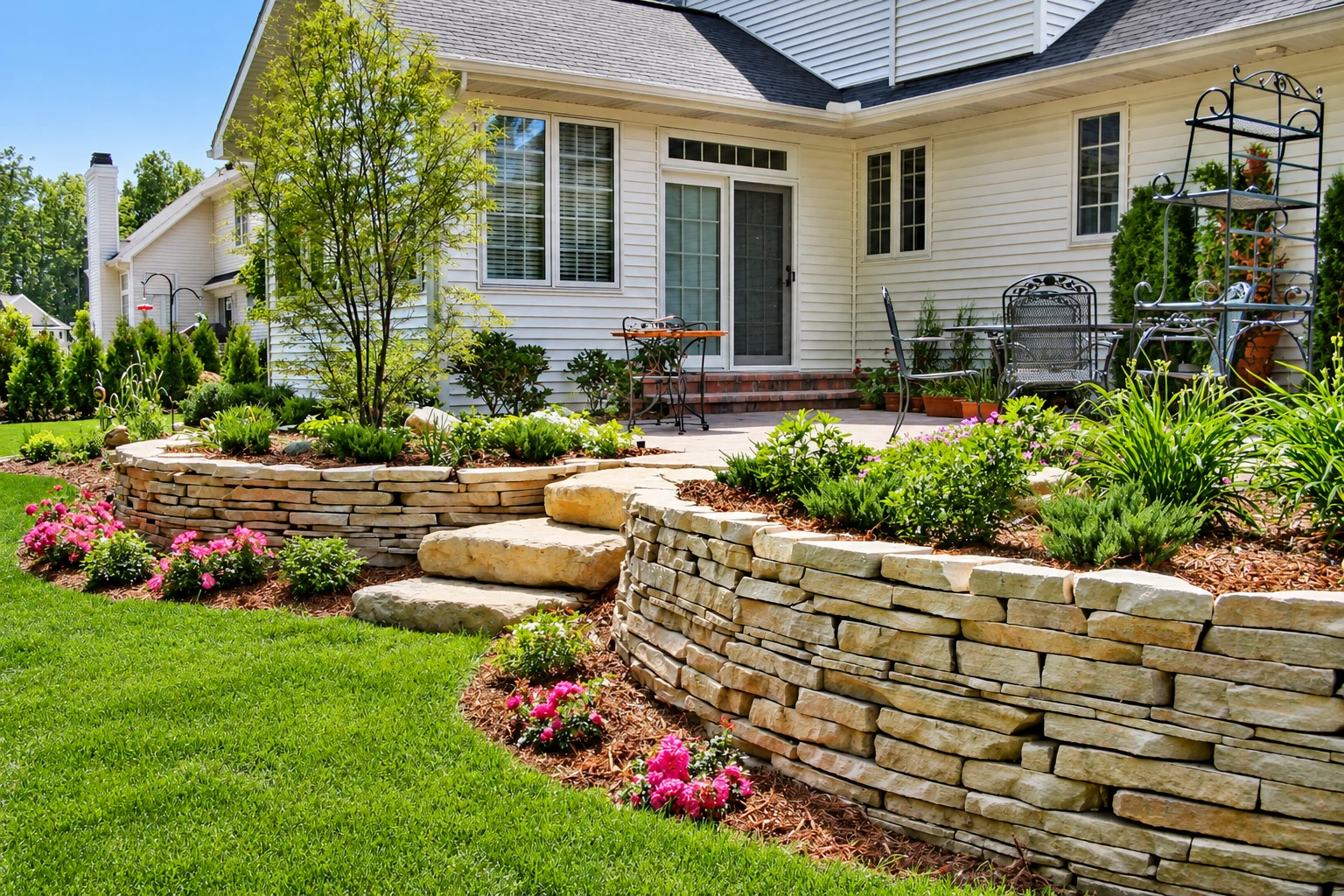
New mortared stone wall
This suits a garden wall, planter, column or steps you want solid and lasting. We pick stone and mortar that sit well with your house, so it looks like it was always there.
Dry-stacked stone wall
This suits terraced beds and a more natural look, with no mortar joints to keep up. It takes patient building, because the fit of the stones is what holds it together.
What happens when you call about stone masonry in Springdale?
It's a short process. You tell us about the wall, I come and look at it, and you get a clear picture of what's wrong and what it would take before anything starts.
- Step 01
Call or send the form
Tell us what the wall is doing and we'll set a time for me to come out. Photos and a rough size help me show up with the right questions.
- Step 02
I look the wall over
I check the joints, the stone and where the water goes, then walk you through what's behind the trouble, what I'd do about it and what it costs. If part of it can wait, I'll tell you so.
- Step 03
We sort permits and start
Once you're ready, we look into whether your job needs a permit and take care of it if it does. Then our crew gets to work.
- Step 04
Walk the finished wall together
When the work's done, we go over the finished wall with you. The site is cleaned up before we call it finished.
Stone masonry rules and ground around Springdale
In Arkansas, the state licenses home improvement contractors, and the law counts anyone who bids on or runs repairs, improvements or additions to an existing single-family home. It reaches the home's property and the structures that go with it too, so a stone garden wall, steps or a wall in the yard falls under it, not just the house. The state's Residential Contractors Committee handles that licensing, so it's fair to ask anyone bidding on your wall about it. Permits are a separate question that depends on the job and your address, so before work starts we check with the city or county office for your address and apply for one when it's needed.
The ground changes a lot across this part of the state. Washington County runs from steep, stony mountainsides across its southern two-thirds to deeper, gentler soils in the north that are cut by steep V-shaped draws, which is why I want to see your lot before saying how a wall should be built. We're based in Springdale and work across it and the cities around it, and we meet sloped yards and stony banks on jobs in Fayetteville and Farmington just as often.
Get a stone masonry estimate for your wall
Send the form with a few photos, the wall's rough size and whether it's mortared or dry-stacked, and we'll reply within one business day. I'll set a time to come out for a free on-site estimate, and there's no obligation.
Why Springdale homeowners call Sterling Springdale Concrete and Masonry
I come out and estimate
I'm the one who looks at your wall and gives the estimate, and our crew does the work with me on site most of the time. The person who worked out what went wrong is usually right there while it's being fixed.
Thirteen years finding the cause
We've been in business since 2013, and I came to masonry after years working on machinery, learning the trade beside an experienced mason. That's why I'd rather find out why a wall failed than patch it, because a patch over the real problem just comes back.
Covered for work on your lot
We're fully licensed and insured. That matters on stonework because, as I said above, the state's contractor licensing reaches walls and structures on your property, not just the house.
On stone, the mortar that goes back in and how carefully the old comes out decide how long the work lasts. Tell us about your wall and I'll come take a look.
Stone masonry questions from Springdale homeowners
Can modern cement mortar damage an old stone house?
Yes, on older stone it can. In historic buildings the mortar is meant to be the sacrificial part, letting moisture work out through the joints so the stone stays sound, and repointing with a harder modern mortar such as Portland cement can leave the stone soaking up water until it fails. So on an older house we choose the mortar for how it behaves with your stone, not just for how it looks.
What is the best way to remove old mortar from stone joints?
On older stone, hand chisels and a mash hammer are usually the safest way. They take more labor, but in most cases they carry the least risk to historic masonry and give the best result, while grinders and power saws are the common shortcut and can be disastrous in unskilled hands. Wide stone joints may need the old mortar raked out several inches deep, which is something I check on the estimate visit.
How much does stone veneer cost in Springdale, AR?
Installing stone veneer in the Fayetteville-Springdale area usually costs about $2,200 to $8,500 per job. That's the area's typical price for veneer work, not a quote from us, and repointing or a freestanding stone wall is a different job priced on its own. You get your own figure from the on-site estimate once I've seen the wall.
How long does a dry-stacked stone wall last?
A well-built dry-stacked wall can last a very long time, and many stone walls the Civilian Conservation Corps built are still doing their job today. What separates a good wall from a poor one is careful building, mainly interlocking the stones and tying them to the soil behind the wall. When I look at a failing dry wall, that's usually where it went wrong.
What causes stone walls to deteriorate?
Water does most of the damage, whether it's rain soaking in, splashing up onto the wall or soaking back in from the ground. The best practice is to steer water away before it gets into the wall, so along with the stonework we look at where your gutters, downspouts and grading send it.
What's the difference between a mortared stone wall and a dry-stacked wall?
A dry-stacked wall, sometimes called a rockery, uses no mortar at all and stays put through the weight, size, shape and friction of the stones. A mortared wall depends on its joints, and since masonry wears at the joints first, it needs repointing now and then, which is raking out the worn mortar and packing in new. Which one suits your yard comes down to the look you want and the job the wall has to do.
Related masonry work for stone homes
Brick pointing
If your house mixes brick with stone, worn brick joints let water in the same way, and catching them early keeps bricks from loosening around windows and chimneys.
Foundation repair
When cracks run through stone and keep opening, or doors start sticking nearby, the trouble may sit under the wall, and that needs fixing before any repointing lasts.
Call about your stone wall today
We pick up seven days a week until 11 at night, so call (479) 231-3391 while you're standing there looking at the wall.